March Theme 2026
By Judith Lynch

We welcome March 1st with open arms as the beginning of spring in the northern hemisphere, although the Spring Equinox is not until 20th March. The symbol of this month is probably daffodils and other bulbs which have pushed their roots down into the earth and their leaves and flowers up from the ground to provide us with spring colour, perfume and joy. They embody the renewal of energy and strength in our lives.
The lunar eclipse and blood moon on March 3rd marks the culmination of Chinese New Year. This is The Year of The Fiery Horse. It too represents strength and energy. My thoughts turn to yoga and how important strength is for our muscles, joints and bones, plus energy for our overall wellbeing.
I found out aged 56 my bone density is low. It dropped lower into osteoporosis but following treatment I was able to improve somewhat and am now assessed as osteopenic – just above osteoporosis. I have thankfully never broken a bone but as we tend not to be assessed by Dexa scan until we do so there may be other people, maybe yourself or students you teach, who are unknowingly in this same boat. In my class of students aged mid 60 to 87 there are roughly one third of us who have either bone density problems or other back issues. Younger students of course also need to make sure their yoga activities help them maintain muscle and bone strength, care for their backs and improve their balance to help ward off osteoporosis or other problems.
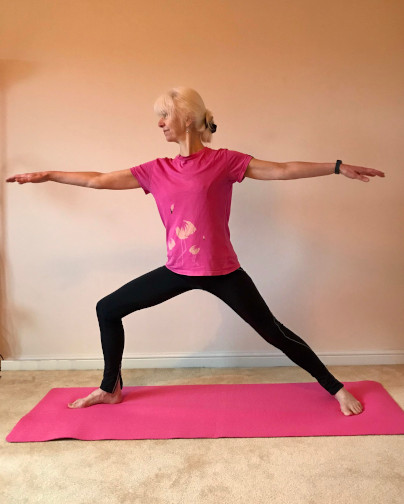
For yourself (and for your students if you teach) yoga standing postures are particularly helpful for strengthening muscles, bones and joints in the legs, arms and lower trunk and back. Warrior poses outstandingly so. Trikonasana and Parsvakonasana as well and these are equally suitable for those with osteoporosis/osteopenia. If a slipped disc or lower back issue is present a modification could be straighter feet, firming the stomach muscles to support the lower back or simply not extending too far. Unlike other forms of exercise such poses as Downward Dog, arm balances or resistant pushing against the wall (flat back forward bend) or floor (cat pose) places weight on the wrists, a frequent area of fractures. Improving balance is of course also essential for leg and hip strengthening and to avoid falls. For confidence if balance is poor, or if fearful of falling and breaking a bone, you can of course work near a wall or holding onto a chair.
Moving onto forward, back bends and twists when you have either bone density or other back issues. The general advice over the years has been to be careful in each type of posture not to compress the vertebrae. Cat pose can be practised but gently and mindfully or simply work with a flat back and pelvic tilts instead. Standing forward bends are safest performed with a flat back and possibly bent knees or at least not hanging too far towards the floor. Even child’s pose could be a problem. Rest chin on hands or practise side cat if preferred. In seated forward bends keep a flattish back and do not lower the head. Similarly with back bends – better not to arch too far back and maybe keep head in alignment. Standing twists should allow hips to move round with the upper body or limit rotation. I would suggest seated twists should be moderated. Experienced yogis can try a little more slow and mindful rotation but stop if any back twinges and moderate accordingly. I think another mindful way of practising twists is to use 3 breaths and move each part of the spine slowly into the posture, moderating if too stiff. (See Kathryn’s excellent description of this in CYTA February theme) If you like Thread the Needle twist, normally practised on all 4s, a tip I picked up from my Pilates teacher (who is currently nursing a slipped disc) is to practise it standing with one hand on the wall, standing sideways on, and threading opposite arm through.
Generally caring for our backs as we do so well in yoga is helpful. Spinal alignment postures – tadasana, crocodile and savasana are excellent. Spinal extension work may be rather less so if students have back problems. Head, neck and shoulder exercises build strength in the upper body and improve posture. If you like practising core strength work the “spine safe” practice lying on your back is to keep knees bent, feet on the floor or raised into table top. It is also recommended to bend your knees if lowering raised legs, engaging tummy muscles to support your back.
Of course health advice changes over the years. Checking the Osteoporosis Society website they are less firm on the contraindications than they were in the past, particularly if there have been no broken bones. Exercise and diet are key. NHS are perhaps a little more cautious, as I am. As usual the main thing for yogis is to listen to their own body and accept and adapt to any changes with grace.
On a final note, as we know, another benefit of yoga practice is that it lowers levels of the stress hormone cortisol. Apparently too much cortisol can increase the breakdown of bone density and decrease bone formation.
Namaste
Judith Lynch